Showing posts with label Pinellas. Show all posts

Friday, December 4, 2009

Tile to Tile Transition....

Often here in Florida when doing a new tile installation we come across
other rooms that already have tile in them that we need to tile up to.
Usually a carpet or laminate area that the homeowner wants to remove and have new tile installed and the new tile we are installing will run into another tiled room (ie: kitchen, bath, hall bath, laundry, etc.).

So my common practice is to direct the customer/home owner to let me install an "Indian Blanket" cut tile pattern to divide those two tiled area's up to really define each area. Also if by chance the grout joints almost align it would look like a failed attempt to line up one tiled area to another new tiled area. Thus this method will break up the direct grout lines.

You could cut the corners off a field tile and install the diamonds side by side, use a few strips of 2x2 mosaic or even a deco tile. This can also be used when two types of tile run into each other in an open area like when trying to divide a straight laid tiled room into a diagonal tiled room.

Here is a recent one we did where the homeowner wanted us to remove the carpet throughout the home and old tile in the front foyer and install a new 20x20 Porcelain tile in their town house/condo at the beach in Tarpon Springs, Florida. They wanted to leave the kitchen tile since it was new and they liked it.

Here are few other examples of "Indian Blanket" door patterns.

.....Example 1.........Example 2.........Example 4........Example 5


www.ceramictec.com
.
.

Friday, November 20, 2009

Importance of Waterproofing a Shower....

Being a Professional Tile Contractor/Installer in Tampa, Florida and helping out on tile help forums I have noticed people are always asking about info on damaged showers and tubs for water damage, rot, grout discoloration, efflorescence, leaks or black mold.

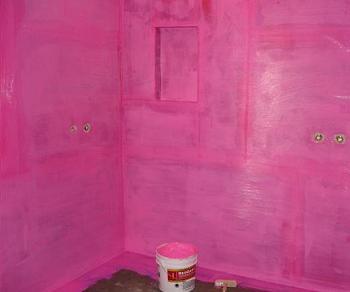
The lack of a pan liner or surface membrane is usually the main reason these problems occur. Professional tile contractors who know the importance of a properly built shower with a pan liner & pre-slope, a bonded waterproofing sheet membrane or a liquid applied membrane.

Mold and rot occur when water gets absorbed into the grout and then seeps into the cementboard or drywall and then starts rotting the studs. Also when drywall is used the problems are even worse because the mold feeds on the paper face of the drywall. Mold loves cellulose and spreads throughout the damp wet area behind your wall.
As the leak goes unnoticed the damage and mold become worse.

When a shower liner is used without a pre-slope the water sits in the mud pan and slowly deteriorates/breaks down the mud bed and fills with mold/sludge. Sometimes the weep holes then become clogged with calcium deposits and efflorescence forms on the grout joints from the water drying up through the grout to the surface. A bonded surface membrane will solve these problems.

While we still do and have been doing traditional pan liners for as long back as I have been doing tile for (21 years), newer, updated ways of waterproofing a shower have been developed like Schluter Kerdi, Noble TS, Laticrete HydroBan Laticrete Hydro Barrier & Custom Building Products Redgard.
All excellent surface applied waterproofing membranes.

I tell customers it's good to spend the extra money now to do it right or you will spend 3 times the money tearing it out a few years later by doing it wrong.

Friday, October 30, 2009

Tile Selection in Florida......

Ceramic, Porcelain, Marble or Stone?

The selection of tile is almost limitless, especially here in Florida where there are so many domestic and imported tile from around the world shipped here.
Many homeowners are taking the selection of their tile more seriously than ever before. The old traditional look of 4x4 or 6x6 ceramics on the walls and floors is falling to the wayside as consumers look for the perfect tile for their projects.

Then, of course, comes the question: What is the best choice?
Tiles come in a wide variety of materials including clay, porcelain, and even glass among other choices. The durability of tile is graded in hardness. The more dense the tile, the harder the finished surface is. Porcelain, for instance, is the best tile in terms of density and hardness. Porcelain tile has color all the way through the tile versus screen print or glazed tiles, which are basically painted only on the surface. Porcelain will lasts longer with fewer problems with wear. Porcelain is also preferred for outside installations because it is more frost resistant.

Marble and stone are in a class all by themselves. Natural stone tile require more care in selection and maintenance. Installation of these materials is more labor intensive requiring a greater degree of skill and know-how to install them. Prices for stone materials are typically higher than ceramic or porcelain tiles and installation costs reflect the degree of difficulty to install them. Stone tile bring nature into your Florida home. They add a feeling of luxury and permanency. Granite counter tops in kitchens and baths combined with a tumbled marble backs plash make for a classy look and feel to any Florida home.

The tile you select for your project is just as important as the installer. Leave some money in your budget for a quality tile job. Once installed, tile can't be changed as easily as your paint color. Consider all the options and textures for tile and plan to spend a day or two looking at several different distributors. Be careful of discount tile, as it is sometimes inferior in quality and ultimately will make for a bad tile job. Remember, you get what you pay for. Don't skimp on your tile project. It will costs much more down the road to repair or replace your tile if done incorrectly and cheap.
Tampa Bay ,Lutz ,Oldsmar ,Apollo Beach, Ybor City, Gibsonton, Carrollwood, Northdale, Lake Magdalene, Palm River-Clair Mel, Progress Village, Riverview, Temple Terrace, University, Westchase, Wesley Chapel, Hillsborough County,
...............Ceramic..........................Porcelain................Marble/Natural Stone

Apollo Beach, Bloomingdale, Boyette, Brandon, Cheval, Citrus Park, Dover, East Lake-Orient Park, Egypt Lake-Leto, Fish Hawk, Gibsonton, Greater Carrollwood, Greater Northdale, Greater Sun Center, Keystone, Lake Magdalene, Lutz, Mango, Palm River-Clair Mel, Pebble Creek, Plant City, Lakeland, St. Pete, Progress Village, Riverview, Ruskin, Seffner, Tampa, Temple Terrace, Thonotosassa, University, Valrico, Westchase, Wimauma, TAMPA FL

Wednesday, October 28, 2009

Grout and Sealers for Tile.........

since we are a Ceramic, Quarry, Saltillo, Porcelain & Travertine
Tile Contractor in Florida these questions come up to us a lot
from Homeowners, Builders, Architects & Customers.

I hope this will explain to you some of the differences.

Grout:

Grout for ceramic tile is a cement-based bonding material used for filling joints between tiles. The space left between tiles to be filled is called a grout joint. The grout joint between the tiles is usually very porous, therefore, it needs to be sealed and maintained properly to prevent stains and discoloration. Protected tile and grout for ceramic tile will be easier to clean, more resistant staining, and provide a safer and healthier environment.

Types of grout for ceramic tile:

There are four basic types of grout for ceramic tile: Unsanded, fine sanded, quarry type and epoxy.

* Unsanded grout for ceramic tile: This is used for wall tiles where the grout joint is less than 1/8" wide.
* Finely Sanded grout for ceramic tile: This is used for floor tiles where the joints are 1/8" to 3/8" wide.
* Quarry-type grout for ceramic tile: This is the same as finely sanded grout for ceramic tiles except that a coarser grade of sand is used. The quarry-type grout for ceramic tile is used for joints that are 3/8" wide to 1/2" wide such as those used with Saltillo tiles.
* Epoxy grout for ceramic tile: This consists of an epoxy resin and hardener. Epoxy grout for ceramic tile is highly resistant to stains and chemicals and has a tremendous bonding strength. It is ideal for countertops and other areas susceptible to stains.

Some important considerations when choosing grout for ceramic tile:

* The wider the joint, the coarser the sand has to be. The sand prevents the grout for ceramic tile from shrinking and cracking.
* Grout for ceramic tiles comes in a wide variety of pre-mixed colors.
* The standard size of wall joint is 1/16" wide.
* The standard size of grout joint for floor tiles is 1/4" wide (finely sanded).
* Because floor tiles may vary slightly in size, grout joints in the floor tiles should not be smaller than 3/16". The installer will not be able to keep a straight line if the joint is too narrow.
* Impregnating sealers go into the grout joint and protect against water and oil-based stains.
* To prevent or limit staining problems in grout for ceramic tile, latex additives or a sealer is recommended. The latex additive forms a rubber-like film over the pores in the grout for ceramic tile, thus limiting its tendency to absorb stains. However, it is not completely stain proof.


Sealers:


A sealer is a liquid coat applied to the porous surface of the tile or grout, to protect them from oxidation, natural deterioration and day-to-day wear. Typically speaking, sealers are used to protect unglazed tiles and grouts from absorbing stains. Take a look at these guidelines, which are meant to get you started when it comes to choosing the right sealant for your ceramic or porcelain tile project:

Types:

There are two types of major types of sealers for ceramic tile or porcelain tile:

* Penetrating Sealers: These are absorbed into the tile or grout, forming a stain resistant shield just below the surface. Most penetrating sealers will not change the appearance of the tile.
* Surface Sealers: These are coated on the top of tile and grout, forming a non-porous, stain resistant sealant. The surface sealer will enhance the rich natural colors of the tile and adds a slight luster as well.

Important Considerations:

* The surface of most ceramic and porcelain tiles does not need to be sealed, although some require a light application of a penetrating sealer to fill the micro pores on the surface of the tile.
* However, all unglazed tiles including dense porcelains, should be sealed prior to grouting. It will prevent the grout from staining the tile, especially when a dark colored grout is being used with a light colored tile.
* Impregnating sealers go into the grout joint and protect against water and oil-based stains.
* Highly absorbent tiles such as hand made Saltillo tiles must be permanently sealed with either a penetrating or surface sealer.
* Use only penetrating sealers on dense, unglazed tiles such as quarries or porcelains.
* It is important to follow your distributor's recommendations as well as reading the instructions on the product being used.


It's a good idea to ask the experts about which type of sealer performs best for the type of tile you have for further details. If color change is a concern, or staining resistance, then these are the questions to put to your seller. Talk to your ceramic or porcelain sales rep, or your local retailer about the latest products for sealing ceramic tile, porcelain tile, quarry tile, saltillo tile or travertine tile. Ask about whether penetrating sealers vs. surface sealers with regard to your specific tile and aesthetic expectations & find out which is the best fit for your project.

Saturday, June 6, 2009

Welcome To Ceramictec's Blog

This informational portal is to provide a informative flooring tips for Florida homeowners interested in “Quality Tile Installations".

We also strive to help homeowners explore the many options available in flooring by featuring quality products from only the best manufacturers.

Remember Do-It-Yourself can sometimes be more trouble than it’s worth, always consult a professional flooring contractor before attempting to DIY.

it can save you lots of time and money and your safety it also paramount.


.

What to look for when hiring a Tile Contractor

I have recently came across a lot of homeowners only looking at the bottom dollar amount when hiring a flooring contractor.
Would you rather spend $2000 and it may last a year,
or spend $3500 and get a lifetime of enjoyment out of your purchase?
You would be wise to do your homework when choosing your contractor. In the past few weeks Ceramictec has torn out 2 showers, that have leaked within the year of being completed. One shower was installed by a concrete contractor.
I think he figured putting thin set under the tiles or pouring concrete was about the same.
The homeowners aren’t thinking so now. Just because they did a nice job on your floor, or kitchen back splash, don’t take it for granted that they can do the same with your shower.

Make sure you ask questions.

Ask them if they put a preslope in?
How do they waterproof the shower?
What type of adhesive do they use?
Mastic or thinset?
How do they keep the weep holes around the drain clean?
How do they fasten the liner on the curb?
How many inches above the pan are they nailing the liner?
Are they using drywall or cement board?

These are just a few simple questions that can save
you a lot of Time, Money & Grief in the near future.