Showing posts with label porcelain. Show all posts
Showing posts with label porcelain. Show all posts
Saturday, June 18, 2016
Tampa Tile Contractor Ceramictec
With everything being facebook these days, I want everyone to know about ceramictec.com. Check it out, scan the gallery, browse the testimonials and read the tile blogs!


Friday, January 15, 2016
South Tampa, Florida 3rd floor & kitchen condo project
Final photos of the 24x24 Tarsus Grey polished porcelain tile on the South Tampa, Florida 3rd floor & kitchen condo project #tile #tampa #24x24 #porcelain #polished #condo #ceramictec


Sunday, April 5, 2015
Porcelain wood look plank tile that is dog, kid and moisture approved!
Porcelain "wood look" plank tile that is dog, kid and moisture approved!
6x24, 6x36, 6x40, 8x36, 8x40 or 8x48 wood look plank tile installations in the Tampa area #tile #planktile #woodlook #woodfloorinng #fauxwood #porcelain #moistureproof #scratchproof #dogproof #kidproof

6x24, 6x36, 6x40, 8x36, 8x40 or 8x48 wood look plank tile installations in the Tampa area #tile #planktile #woodlook #woodfloorinng #fauxwood #porcelain #moistureproof #scratchproof #dogproof #kidproof
Saturday, March 14, 2015
South Tampa, Florida 12x24 porcelain tile small bathroom floor


Wednesday, September 17, 2014
Laundry room tile installation Tampa, Florida
Finished the "Westchase" Tampa, Florida 13x13 laundry room tile installation with tile base. Removed the old 12x12 porcelain #tile #westchase #tampa #ceramictec


Friday, May 23, 2014
18x18 Noce porcelain tile installation Tampa Palms, Florida
Finished the Tampa Palms, Florida bedroom & hall bath project using the Bernini 18x18 Noce matte porcelain tile #tile #bernini #18x18 #porcelain #tampapalms


Thursday, May 22, 2014
Large-format tile installation Tampa Palms, Florida
Awarded a Kitchen & Hall bath 18x36 Olympia "Clay Series" large format rectified porcelain tile installation in Tampa Palms, Florida #tile #rectified #largeformat #porcelain #tampapalms #ceramictec

18x18 porcelain tile installation Tampa Palms, Florida
Using the MLT System to install 18x18 Bernini "Noce" matte finish porcelain tile on the Tampa Palms, Florida project #tile #18x18 #porcelain #tampapalms #ceramictec


Tuesday, February 5, 2013
St. Petersburg, Florida porcelain plank wood look tile installation
finished another porcelain plank wood look tile installation today. this one was in St. Petersburg, Florida and was a den/living room. the tile was Florida Tile 6×24 “Berkshire” Hickory. grout used was Laticrete PermaColor “Chestnut Brown”.
http://bit.ly/YBSklD


Sunday, January 13, 2013
Wood look plank tile installation
plank tile installation in Tampa, Wesley Chapel, Lutz, Brandon, Bradenton, Lakeland, Sarasota, St. Petersburg and also other area’s in Florida.
http://bit.ly/UhfaxxSaturday, November 24, 2012
Wesley Chapel, Florida wood plank tile install
had a return customer call and wants me to do a plank tile install in their living room & hall
http://i46.tinypic.com/30vc32h.jpgMonday, November 12, 2012
New Port Richey, Florida porcelain plank tile installation
set up an estimate to look at installing porcelain plank tile in a home in New Port Richey, Florida
Saturday, April 24, 2010
Ceramic Tile Shower – Tampa, Florida
Rip Out, Prep, Waterproofing, Install Tile:
We completed a hall bath shower rip out & replace in Tampa for a Architect we know. This is his personal home and is Florida and is about 30 years old. The shower pan was done incorrectly and it didn’t have a pre-slope under the liner, had a drain directly connected to the drain pipe and was nailed at the bottom through the liner to the studs. Whoever built this shower pan had no idea on how to build a properly waterproofed traditional pre slope pan & liner. Where would the water go that saturates the mud bed without having weep holes? Something us professionals don’t like seeing.
Being a Tile Contractor in Tampa there was something else I didn’t like seeing, it was the way they did a fake wall mud tile job look. They pretty much put cement board over top drywall and used mastic with 4×4 wall tile and a mud cap A-4200. It gives the look of a built out mud wall but not an actual good way of doing it. Mastic is NEVER good in a shower or wet area and can re-emulsify when wet over time. We demoed the whole old shower area, removing the wall tile, cementboard, old drywall, shower floor tile, mud bed, liner & drain.
We then installed the new cement board, mesh taped the joints and used thinset over them. Installed a new Ebbe drain riser and drain and a new mud bed using Laticrete 3701 fortified mortar bed. The 3701 is a thick-bed mortar that is exceptionally strong and resistant to weather, frost, thermal and physical shock, pre blended and perfect for a job like this. After the cement board and mesh tape was up and the Mud bed cured we used HydroBan liquid waterproofing on the shower pan and up the walls and over the shower curb. We used the divot method to tie the waterproofing into the clamping ring drain, and the filled the divot, packed with pea gravel, mud and more HydroBan over it.
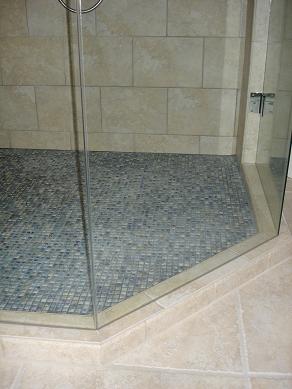
Once the HydroBan was dry we then laid out our wall tile to achieve the best full size cuts in the corners. The tile we were using picked out by the Homeowner was a Floor Gres 4×4 Ceramic White tile with scalloped edges. He also selected Spanish style red rectified porcelain 16×16 tile to go on the bath floor from a local tile showroom. We also cut the 16×16 floor tile down to match the size of the Ebbe drain grate.
The installation went great since our wall and floor prep was done correctly. The scalloped edged tile were hard to put up since the varying sized grout joints could not take a spacer, so for that we used an non sag mortar from Laticrete called MultiMax 255 which held the tile in place and didn’t allow them to slide, better then using a ledger board and spacers. We then set the rectified floor tile with 3/16″ grout joints per the owners request. He purchased a matching red grout for the main floor and the shower floor and a bright white sanded grout for the wall tile, both grouts were Pro Spec 700 sanded grout.
Grouting went easy and we cleaned up and final washed the tile and turned it over to the homeowner. He was very pleased with how it came out and could not believe the before and after look of his bathroom. The owner was going to install a hard Ipe wood for his curb. I usually suggest a marble sill or tile on the curb, but seeing how the dense cell structure of IPÊ (all heart wood) is not only naturally resistant to insects but also to decay, rot, molds and weather has little to no effect upon the structural integrity of IPÊ wood, it would do good as a shower curb sill. He was also going to urethane seal it and I suggested to him to attach it with either an epoxy or a polyurethane construction adhesive like Liquid Nail or PL Premium.
below are some pictures taken during to project, I hope you enjoy them.


We completed a hall bath shower rip out & replace in Tampa for a Architect we know. This is his personal home and is Florida and is about 30 years old. The shower pan was done incorrectly and it didn’t have a pre-slope under the liner, had a drain directly connected to the drain pipe and was nailed at the bottom through the liner to the studs. Whoever built this shower pan had no idea on how to build a properly waterproofed traditional pre slope pan & liner. Where would the water go that saturates the mud bed without having weep holes? Something us professionals don’t like seeing.
Being a Tile Contractor in Tampa there was something else I didn’t like seeing, it was the way they did a fake wall mud tile job look. They pretty much put cement board over top drywall and used mastic with 4×4 wall tile and a mud cap A-4200. It gives the look of a built out mud wall but not an actual good way of doing it. Mastic is NEVER good in a shower or wet area and can re-emulsify when wet over time. We demoed the whole old shower area, removing the wall tile, cementboard, old drywall, shower floor tile, mud bed, liner & drain.
We then installed the new cement board, mesh taped the joints and used thinset over them. Installed a new Ebbe drain riser and drain and a new mud bed using Laticrete 3701 fortified mortar bed. The 3701 is a thick-bed mortar that is exceptionally strong and resistant to weather, frost, thermal and physical shock, pre blended and perfect for a job like this. After the cement board and mesh tape was up and the Mud bed cured we used HydroBan liquid waterproofing on the shower pan and up the walls and over the shower curb. We used the divot method to tie the waterproofing into the clamping ring drain, and the filled the divot, packed with pea gravel, mud and more HydroBan over it.
Once the HydroBan was dry we then laid out our wall tile to achieve the best full size cuts in the corners. The tile we were using picked out by the Homeowner was a Floor Gres 4×4 Ceramic White tile with scalloped edges. He also selected Spanish style red rectified porcelain 16×16 tile to go on the bath floor from a local tile showroom. We also cut the 16×16 floor tile down to match the size of the Ebbe drain grate.
The installation went great since our wall and floor prep was done correctly. The scalloped edged tile were hard to put up since the varying sized grout joints could not take a spacer, so for that we used an non sag mortar from Laticrete called MultiMax 255 which held the tile in place and didn’t allow them to slide, better then using a ledger board and spacers. We then set the rectified floor tile with 3/16″ grout joints per the owners request. He purchased a matching red grout for the main floor and the shower floor and a bright white sanded grout for the wall tile, both grouts were Pro Spec 700 sanded grout.
Grouting went easy and we cleaned up and final washed the tile and turned it over to the homeowner. He was very pleased with how it came out and could not believe the before and after look of his bathroom. The owner was going to install a hard Ipe wood for his curb. I usually suggest a marble sill or tile on the curb, but seeing how the dense cell structure of IPÊ (all heart wood) is not only naturally resistant to insects but also to decay, rot, molds and weather has little to no effect upon the structural integrity of IPÊ wood, it would do good as a shower curb sill. He was also going to urethane seal it and I suggested to him to attach it with either an epoxy or a polyurethane construction adhesive like Liquid Nail or PL Premium.
below are some pictures taken during to project, I hope you enjoy them.


Monday, January 25, 2010
Commonly used Tile in Florida Definition….
to view our current blogs go to our website or read the original here.
http://ceramictec.com/commonly-used-tile-in-florida-definition
At Ceramictec we install the finest selection of name brand tile with the widest selection of patterns, textures, sizes and colors. No matter what your decor or color scheme we can help you find the perfect tile for your home decorating.
* Stain Resistant
* Scratch Resistant
* Fire Resistant
* Doesn’t Fade from Sun Light
* Easy to Clean
Porcelain Tile — Is a tile that is generally made by the dust pressed method from porcelain clays which result in a tile that is dense, impervious, fine grained and smooth, with a sharply formed face. Porcelain tiles usually have a much lower water absorption rate (less than 0.5%) than non-porcelain tiles making them frost resistant or frost-proof. Glazed porcelain tiles are much harder and more wear and damage resistant than non-porcelain ceramic tiles, making them suitable for any application from light traffic to the heaviest residential and light commercial traffic. Full body/though body porcelain tiles carry the color and pattern through the entire thickness of the tile making them virtually impervious to wear and are suitable for any application from residential to the highest traffic commercial or industrial applications. Porcelain tiles are available in matte, unglazed or a high polished finish.
Glazed Tile — Most of the common ceramic floor tiles have either a glazed, or unglazed surface. The glazed tiles have a special ceramic coating that is applied to the body of the tile and then fired under high heat. The glazing becomes hard.
Unglazed Floor Tile — There is no glazing or any other coating applied to these tiles. Because these tiles are porous it is recommended that a special penetrating sealant be used to maintain this type of floors and to help prevent stains from seeping into the pores of the tiles. Their color is the same on the face of the tile as it is on the back resulting in very durable tiles that do not show the effects of heavy traffic.
Marble — Marble is a natural product and is not made in a factory. For this reason no two pieces of marble look the same and the veining is a natural characteristic in all marble. One of the more popular marble tile in Florida is Travertine. There are special marble sealants to help protect from staining of the face. Extra care should be used when cleaning and all abrasives and acidic cleaners should never be used when cleaning. Even colas, some juices, and possibly ammonia may destroy the marble finish.
Granite — This is another natural stone and is not manufactured in a factory. Granite can be used indoors or outdoors and is less porous than marble. It is still recommended that you use a sealant to protect the finish from staining.
Grout — Grout is a mixture of cement and a color additive. For tile floors with wider spaces between each tile sand is added to the grout. Also, a liquid latex additive can be added to the grout to give better resiliency to the grouted areas. For ease of maintenance a penetrating sealant should be used on the grout. It should be noted you may see a change in color of your grout over time. To stop this we highly recommend an upgrade to an epoxy grout.
Some of the other important things we can help with when selecting a tile floor is the slip-resistance, the size and color of the grout joints, the thickness of the tile, height variations from room to room, size of the tile, suitability of the subfloor, and cleaning of the tile.
If your interested in getting a Free Estimate Please Contact Us.
.
.
.
http://ceramictec.com/commonly-used-tile-in-florida-definition
At Ceramictec we install the finest selection of name brand tile with the widest selection of patterns, textures, sizes and colors. No matter what your decor or color scheme we can help you find the perfect tile for your home decorating.
* Stain Resistant
* Scratch Resistant
* Fire Resistant
* Doesn’t Fade from Sun Light
* Easy to Clean
Porcelain Tile — Is a tile that is generally made by the dust pressed method from porcelain clays which result in a tile that is dense, impervious, fine grained and smooth, with a sharply formed face. Porcelain tiles usually have a much lower water absorption rate (less than 0.5%) than non-porcelain tiles making them frost resistant or frost-proof. Glazed porcelain tiles are much harder and more wear and damage resistant than non-porcelain ceramic tiles, making them suitable for any application from light traffic to the heaviest residential and light commercial traffic. Full body/though body porcelain tiles carry the color and pattern through the entire thickness of the tile making them virtually impervious to wear and are suitable for any application from residential to the highest traffic commercial or industrial applications. Porcelain tiles are available in matte, unglazed or a high polished finish.
Glazed Tile — Most of the common ceramic floor tiles have either a glazed, or unglazed surface. The glazed tiles have a special ceramic coating that is applied to the body of the tile and then fired under high heat. The glazing becomes hard.
Unglazed Floor Tile — There is no glazing or any other coating applied to these tiles. Because these tiles are porous it is recommended that a special penetrating sealant be used to maintain this type of floors and to help prevent stains from seeping into the pores of the tiles. Their color is the same on the face of the tile as it is on the back resulting in very durable tiles that do not show the effects of heavy traffic.
Marble — Marble is a natural product and is not made in a factory. For this reason no two pieces of marble look the same and the veining is a natural characteristic in all marble. One of the more popular marble tile in Florida is Travertine. There are special marble sealants to help protect from staining of the face. Extra care should be used when cleaning and all abrasives and acidic cleaners should never be used when cleaning. Even colas, some juices, and possibly ammonia may destroy the marble finish.
Granite — This is another natural stone and is not manufactured in a factory. Granite can be used indoors or outdoors and is less porous than marble. It is still recommended that you use a sealant to protect the finish from staining.
Grout — Grout is a mixture of cement and a color additive. For tile floors with wider spaces between each tile sand is added to the grout. Also, a liquid latex additive can be added to the grout to give better resiliency to the grouted areas. For ease of maintenance a penetrating sealant should be used on the grout. It should be noted you may see a change in color of your grout over time. To stop this we highly recommend an upgrade to an epoxy grout.
Some of the other important things we can help with when selecting a tile floor is the slip-resistance, the size and color of the grout joints, the thickness of the tile, height variations from room to room, size of the tile, suitability of the subfloor, and cleaning of the tile.
If your interested in getting a Free Estimate Please Contact Us.
.
.
.
Thursday, January 21, 2010
Tile Setter’s Advice....
For Florida Bathroom Floor Tiles….
Selecting tile for your Florida bathroom is an area where I feel you should adhere to some basic principals. But, this is also an area where you can let your imagination shine. Various sizes, colors, and textures combined can make your bathroom truly a work of art!
Let’s begin.
* First, you should consider maintenance and ease of such.
* Second, you should consider texture and where to place it.
* Third, colors.
* Fourth, design and design elements consistent with the interior flavor or theme of your home or space.
* Maintenance is often overlooked at the expense of loss of luster and shine over a period of time. Nothing looks worse than a dull and well worn Travertine.
My advice after having busting out many Travertine floors is to consider Granite, Ceramic, Porcelain, or Glass for the bathroom floor. Use a durable non porous easy to clean material. You can use Travertine but remember it needs to be sealed. As a floor surface this can build up if not maintained properly. Like Marble, Travertine is a soft material and requires maintenance and can be stained, scratched, and easily chipped.
Textures on the floors can add an immediate design element. Perhaps a textured material or natural stone placed strategically in the center of the floor or as a perimeter band. Running your floor tile on a diagonal or diamond pattern has the effect of making your room look larger. However, expect to pay anywhere from $1.00-2.00 extra and more for a diagonal diamond pattern per square foot.
Design elements will add to cost as well. As much as $5.00 or more per square foot can be expected. Textures such as tumbled Marble would best be suited on walls. Round Riverbed Stones work well on shower floors and offer somewhat of a therapeutic value. Tumbled Marble or another color of Natural Stone used as a color band if incorporated correctly adds excitement and an “out of the ordinary” point of interest.
Colors. Always remember when using Natural Stone the installation generally costs more because tile setters have to craft, shape, grind, polish and form many pieces of the material. More often than not, there are no pre-formed corners and edges as there are with ceramic tile. And, the process takes a lot more time. You’ll appreciate that more when shelling out more per square foot for the material alone.
Another point to remember is that almost any tile including Natural Stone can have a pattern! You really need to open up a few boxes to determine if you may run into an issue here.For instance, some time ago we installed a Walnut Travertine shower and walls. As I removed tile from the boxes and it was placed on the wall, we could clearly see we had reassembled the cut slab straight out of the box. This is unusual but it happens. In other cases the same grain or flow of colors in Natural Stone be it Granite, Marble, Sandstone, Travertine, and Gemstone may not look good. Dark tile areas might need to be distributed within lighter tiles so you don’t wind up with too many dark or light tiles in one area.
If you are a DIY’er, when setting Travertine floors or walls be sure to use a thinset mortar that closely matches the tile surface color. Lighter Travertine should be placed with white thinset mortar and darker or chocolate Travertine should be set with gray thinset mortar. This is because Travertine is a porous material and your thinset can actually show through the surface or push through on installation. This can appear as a stain.
Design elements enhance the flavor of a space by using colors, textures, and sizes. A simple 6X6 shower enclosure will look much more appealing with a color stripe at the very least at about eye level. Using that same color stripe in other spots like the shower floor or inside a niche adds a little class.
There is a virtual universe of materials, colors, and textures at local distributors to flavor your next project. These additions add simple and attractive sophistication to an otherwise boring bathroom floor or shower.
The materials and ideas are as endless as your imagination and budget.
Be creative !

Selecting tile for your Florida bathroom is an area where I feel you should adhere to some basic principals. But, this is also an area where you can let your imagination shine. Various sizes, colors, and textures combined can make your bathroom truly a work of art!
Let’s begin.
* First, you should consider maintenance and ease of such.
* Second, you should consider texture and where to place it.
* Third, colors.
* Fourth, design and design elements consistent with the interior flavor or theme of your home or space.
* Maintenance is often overlooked at the expense of loss of luster and shine over a period of time. Nothing looks worse than a dull and well worn Travertine.
My advice after having busting out many Travertine floors is to consider Granite, Ceramic, Porcelain, or Glass for the bathroom floor. Use a durable non porous easy to clean material. You can use Travertine but remember it needs to be sealed. As a floor surface this can build up if not maintained properly. Like Marble, Travertine is a soft material and requires maintenance and can be stained, scratched, and easily chipped.
Textures on the floors can add an immediate design element. Perhaps a textured material or natural stone placed strategically in the center of the floor or as a perimeter band. Running your floor tile on a diagonal or diamond pattern has the effect of making your room look larger. However, expect to pay anywhere from $1.00-2.00 extra and more for a diagonal diamond pattern per square foot.
Design elements will add to cost as well. As much as $5.00 or more per square foot can be expected. Textures such as tumbled Marble would best be suited on walls. Round Riverbed Stones work well on shower floors and offer somewhat of a therapeutic value. Tumbled Marble or another color of Natural Stone used as a color band if incorporated correctly adds excitement and an “out of the ordinary” point of interest.
Colors. Always remember when using Natural Stone the installation generally costs more because tile setters have to craft, shape, grind, polish and form many pieces of the material. More often than not, there are no pre-formed corners and edges as there are with ceramic tile. And, the process takes a lot more time. You’ll appreciate that more when shelling out more per square foot for the material alone.
Another point to remember is that almost any tile including Natural Stone can have a pattern! You really need to open up a few boxes to determine if you may run into an issue here.For instance, some time ago we installed a Walnut Travertine shower and walls. As I removed tile from the boxes and it was placed on the wall, we could clearly see we had reassembled the cut slab straight out of the box. This is unusual but it happens. In other cases the same grain or flow of colors in Natural Stone be it Granite, Marble, Sandstone, Travertine, and Gemstone may not look good. Dark tile areas might need to be distributed within lighter tiles so you don’t wind up with too many dark or light tiles in one area.
If you are a DIY’er, when setting Travertine floors or walls be sure to use a thinset mortar that closely matches the tile surface color. Lighter Travertine should be placed with white thinset mortar and darker or chocolate Travertine should be set with gray thinset mortar. This is because Travertine is a porous material and your thinset can actually show through the surface or push through on installation. This can appear as a stain.
Design elements enhance the flavor of a space by using colors, textures, and sizes. A simple 6X6 shower enclosure will look much more appealing with a color stripe at the very least at about eye level. Using that same color stripe in other spots like the shower floor or inside a niche adds a little class.
There is a virtual universe of materials, colors, and textures at local distributors to flavor your next project. These additions add simple and attractive sophistication to an otherwise boring bathroom floor or shower.
The materials and ideas are as endless as your imagination and budget.
Be creative !
Wednesday, October 28, 2009
Grout and Sealers for Tile.........
since we are a Ceramic, Quarry, Saltillo, Porcelain & Travertine
Tile Contractor in Florida these questions come up to us a lot
from Homeowners, Builders, Architects & Customers.
I hope this will explain to you some of the differences.
Grout:
Grout for ceramic tile is a cement-based bonding material used for filling joints between tiles. The space left between tiles to be filled is called a grout joint. The grout joint between the tiles is usually very porous, therefore, it needs to be sealed and maintained properly to prevent stains and discoloration. Protected tile and grout for ceramic tile will be easier to clean, more resistant staining, and provide a safer and healthier environment.
Types of grout for ceramic tile:
There are four basic types of grout for ceramic tile: Unsanded, fine sanded, quarry type and epoxy.
* Unsanded grout for ceramic tile: This is used for wall tiles where the grout joint is less than 1/8" wide.
* Finely Sanded grout for ceramic tile: This is used for floor tiles where the joints are 1/8" to 3/8" wide.
* Quarry-type grout for ceramic tile: This is the same as finely sanded grout for ceramic tiles except that a coarser grade of sand is used. The quarry-type grout for ceramic tile is used for joints that are 3/8" wide to 1/2" wide such as those used with Saltillo tiles.
* Epoxy grout for ceramic tile: This consists of an epoxy resin and hardener. Epoxy grout for ceramic tile is highly resistant to stains and chemicals and has a tremendous bonding strength. It is ideal for countertops and other areas susceptible to stains.
Some important considerations when choosing grout for ceramic tile:
* The wider the joint, the coarser the sand has to be. The sand prevents the grout for ceramic tile from shrinking and cracking.
* Grout for ceramic tiles comes in a wide variety of pre-mixed colors.
* The standard size of wall joint is 1/16" wide.
* The standard size of grout joint for floor tiles is 1/4" wide (finely sanded).
* Because floor tiles may vary slightly in size, grout joints in the floor tiles should not be smaller than 3/16". The installer will not be able to keep a straight line if the joint is too narrow.
* Impregnating sealers go into the grout joint and protect against water and oil-based stains.
* To prevent or limit staining problems in grout for ceramic tile, latex additives or a sealer is recommended. The latex additive forms a rubber-like film over the pores in the grout for ceramic tile, thus limiting its tendency to absorb stains. However, it is not completely stain proof.
Sealers:
A sealer is a liquid coat applied to the porous surface of the tile or grout, to protect them from oxidation, natural deterioration and day-to-day wear. Typically speaking, sealers are used to protect unglazed tiles and grouts from absorbing stains. Take a look at these guidelines, which are meant to get you started when it comes to choosing the right sealant for your ceramic or porcelain tile project:
Types:
There are two types of major types of sealers for ceramic tile or porcelain tile:
* Penetrating Sealers: These are absorbed into the tile or grout, forming a stain resistant shield just below the surface. Most penetrating sealers will not change the appearance of the tile.
* Surface Sealers: These are coated on the top of tile and grout, forming a non-porous, stain resistant sealant. The surface sealer will enhance the rich natural colors of the tile and adds a slight luster as well.
Important Considerations:
* The surface of most ceramic and porcelain tiles does not need to be sealed, although some require a light application of a penetrating sealer to fill the micro pores on the surface of the tile.
* However, all unglazed tiles including dense porcelains, should be sealed prior to grouting. It will prevent the grout from staining the tile, especially when a dark colored grout is being used with a light colored tile.
* Impregnating sealers go into the grout joint and protect against water and oil-based stains.
* Highly absorbent tiles such as hand made Saltillo tiles must be permanently sealed with either a penetrating or surface sealer.
* Use only penetrating sealers on dense, unglazed tiles such as quarries or porcelains.
* It is important to follow your distributor's recommendations as well as reading the instructions on the product being used.
It's a good idea to ask the experts about which type of sealer performs best for the type of tile you have for further details. If color change is a concern, or staining resistance, then these are the questions to put to your seller. Talk to your ceramic or porcelain sales rep, or your local retailer about the latest products for sealing ceramic tile, porcelain tile, quarry tile, saltillo tile or travertine tile. Ask about whether penetrating sealers vs. surface sealers with regard to your specific tile and aesthetic expectations & find out which is the best fit for your project.
Tile Contractor in Florida these questions come up to us a lot
from Homeowners, Builders, Architects & Customers.
I hope this will explain to you some of the differences.
Grout:
Grout for ceramic tile is a cement-based bonding material used for filling joints between tiles. The space left between tiles to be filled is called a grout joint. The grout joint between the tiles is usually very porous, therefore, it needs to be sealed and maintained properly to prevent stains and discoloration. Protected tile and grout for ceramic tile will be easier to clean, more resistant staining, and provide a safer and healthier environment.
Types of grout for ceramic tile:
There are four basic types of grout for ceramic tile: Unsanded, fine sanded, quarry type and epoxy.
* Unsanded grout for ceramic tile: This is used for wall tiles where the grout joint is less than 1/8" wide.
* Finely Sanded grout for ceramic tile: This is used for floor tiles where the joints are 1/8" to 3/8" wide.
* Quarry-type grout for ceramic tile: This is the same as finely sanded grout for ceramic tiles except that a coarser grade of sand is used. The quarry-type grout for ceramic tile is used for joints that are 3/8" wide to 1/2" wide such as those used with Saltillo tiles.
* Epoxy grout for ceramic tile: This consists of an epoxy resin and hardener. Epoxy grout for ceramic tile is highly resistant to stains and chemicals and has a tremendous bonding strength. It is ideal for countertops and other areas susceptible to stains.
Some important considerations when choosing grout for ceramic tile:
* The wider the joint, the coarser the sand has to be. The sand prevents the grout for ceramic tile from shrinking and cracking.
* Grout for ceramic tiles comes in a wide variety of pre-mixed colors.
* The standard size of wall joint is 1/16" wide.
* The standard size of grout joint for floor tiles is 1/4" wide (finely sanded).
* Because floor tiles may vary slightly in size, grout joints in the floor tiles should not be smaller than 3/16". The installer will not be able to keep a straight line if the joint is too narrow.
* Impregnating sealers go into the grout joint and protect against water and oil-based stains.
* To prevent or limit staining problems in grout for ceramic tile, latex additives or a sealer is recommended. The latex additive forms a rubber-like film over the pores in the grout for ceramic tile, thus limiting its tendency to absorb stains. However, it is not completely stain proof.
Sealers:
A sealer is a liquid coat applied to the porous surface of the tile or grout, to protect them from oxidation, natural deterioration and day-to-day wear. Typically speaking, sealers are used to protect unglazed tiles and grouts from absorbing stains. Take a look at these guidelines, which are meant to get you started when it comes to choosing the right sealant for your ceramic or porcelain tile project:
Types:
There are two types of major types of sealers for ceramic tile or porcelain tile:
* Penetrating Sealers: These are absorbed into the tile or grout, forming a stain resistant shield just below the surface. Most penetrating sealers will not change the appearance of the tile.
* Surface Sealers: These are coated on the top of tile and grout, forming a non-porous, stain resistant sealant. The surface sealer will enhance the rich natural colors of the tile and adds a slight luster as well.
Important Considerations:
* The surface of most ceramic and porcelain tiles does not need to be sealed, although some require a light application of a penetrating sealer to fill the micro pores on the surface of the tile.
* However, all unglazed tiles including dense porcelains, should be sealed prior to grouting. It will prevent the grout from staining the tile, especially when a dark colored grout is being used with a light colored tile.
* Impregnating sealers go into the grout joint and protect against water and oil-based stains.
* Highly absorbent tiles such as hand made Saltillo tiles must be permanently sealed with either a penetrating or surface sealer.
* Use only penetrating sealers on dense, unglazed tiles such as quarries or porcelains.
* It is important to follow your distributor's recommendations as well as reading the instructions on the product being used.
It's a good idea to ask the experts about which type of sealer performs best for the type of tile you have for further details. If color change is a concern, or staining resistance, then these are the questions to put to your seller. Talk to your ceramic or porcelain sales rep, or your local retailer about the latest products for sealing ceramic tile, porcelain tile, quarry tile, saltillo tile or travertine tile. Ask about whether penetrating sealers vs. surface sealers with regard to your specific tile and aesthetic expectations & find out which is the best fit for your project.
Saturday, October 3, 2009
Shade Variation in Ceramic & Porcelain Tile....
Many popular styles of ceramic tiles are designed and manufactured to appear and feel like natural stone, imitating their rugged surface and color variation. It's important to understand these variations while selecting and laying out your ceramic tile flooring. You will always be provided with a wide range of glazes, different gloss levels, colors and texture variations to choose from. Your choice should depend on the conditions present at your chosen location, whether commercial or residential.
A commonly preferred choice is a solid color tile because of its consistent look. However, shade variation is a natural factor in all fired ceramic products. In fact, certain tiles will show a certain amount variation even within their dye lots.
For the benefit of better understanding on the part of the consumer, shade variation categories have been devised to enable consumers choose their desired shade spectrum. These shade variation ratings are mentioned on the back label of each sample within either of the low, moderate, high or random categories.
Here is a brief explanation of these categories:
Low: Consistent shade and texture
Moderate: Moderate shade and texture variation
High: High shade and texture variation
Random: Very high shade and texture variation
The color of the tiles body is determined by the color of the clay used to manufacture it. It is usually the clay available in the surrounding regions of the manufacturing facility or sometimes imported from another region. You can have a look at the body of tile to find out if the color is red or white. The quality, however, depends on the processing standards of the manufacturers rather than the color of the body.
Color variations will also be present within the manufacturer's samples of tile of the same color. Moreover, it can be seen throughout the installed tiles on counter tops, walls and floors.
a couple of good tile manufacturers we use at Ceramictec Tile Contractors use are Crossville and Marazzi. to us they are a really good quality porcelain tile and made in the U.S.A.
If you have a particular tendency towards color consistency, then understanding the facts and talking to your tile contractor about your expectations can be a worthwhile pursuit.
some shade variations can be a beautiful thing.
like this full house tile renovation in Lakeland Florida for a customer.


A commonly preferred choice is a solid color tile because of its consistent look. However, shade variation is a natural factor in all fired ceramic products. In fact, certain tiles will show a certain amount variation even within their dye lots.
For the benefit of better understanding on the part of the consumer, shade variation categories have been devised to enable consumers choose their desired shade spectrum. These shade variation ratings are mentioned on the back label of each sample within either of the low, moderate, high or random categories.
Here is a brief explanation of these categories:
Low: Consistent shade and texture
Moderate: Moderate shade and texture variation
High: High shade and texture variation
Random: Very high shade and texture variation
The color of the tiles body is determined by the color of the clay used to manufacture it. It is usually the clay available in the surrounding regions of the manufacturing facility or sometimes imported from another region. You can have a look at the body of tile to find out if the color is red or white. The quality, however, depends on the processing standards of the manufacturers rather than the color of the body.
Color variations will also be present within the manufacturer's samples of tile of the same color. Moreover, it can be seen throughout the installed tiles on counter tops, walls and floors.
a couple of good tile manufacturers we use at Ceramictec Tile Contractors use are Crossville and Marazzi. to us they are a really good quality porcelain tile and made in the U.S.A.
If you have a particular tendency towards color consistency, then understanding the facts and talking to your tile contractor about your expectations can be a worthwhile pursuit.
some shade variations can be a beautiful thing.
like this full house tile renovation in Lakeland Florida for a customer.


Wednesday, June 24, 2009
Ameris Bank Tile Project in Jacksonville, Florida
The Tile was Ergon Engineered Porcelain Tile Alabastro Evo spec'd by
the Ameris Bank & Architect and purchased through Virginia Tile Co.
The Builder was Auld-White Constructors.
Laticrete thinset was used on this project.
255 Multimax on the walls and 252 Silver on the floors.
TEC AccuColor XT #933 Standard Grey was spec'd and used on walls & floors.
**Click on Picture to Enlarge**



.
.
the Ameris Bank & Architect and purchased through Virginia Tile Co.
The Builder was Auld-White Constructors.
Laticrete thinset was used on this project.
255 Multimax on the walls and 252 Silver on the floors.
TEC AccuColor XT #933 Standard Grey was spec'd and used on walls & floors.
**Click on Picture to Enlarge**


.
.
Subscribe to:
Posts (Atom)

